

Inside: homeowners coverage for Alamo Heights, the local context, what drives cost, and a no-guesswork way to compare quotes.
Last updated: October 27, 2026 · Data from NOAA, the U.S. Census Bureau, FEMA and the Texas Department of Insurance
Alamo Heights homes are older and worth more than most of Bexar County, so the right policy is about rebuild cost, roof settlement (how the policy pays for a damaged roof) and hail deductibles as much as price. Insurers look harder at original wiring, plumbing, and roof condition because they raise the chance of a claim. Here is what residents typically pay and how to shop well.
Start here
- Typical cost: about $2,236 a year for a home near the local median value (~$779,400). Our estimates run from about $1,420 for a $300,000 dwelling to about $2,600 for a $1,000,000 dwelling, so the price climbs as dwelling coverage goes up.
- What drives price here: older homes (median year built 1950, about 74% built before 1980), hail risk (40 reports within about 5 miles, 2016–2025), rebuild cost, roof age and material, and wind/hail deductibles.
- Key advice: Focus on roof settlement method (replacement cost vs. actual cash value) and the wind/hail deductible percentage, not just the annual premium. A percentage wind/hail deductible is a storm-specific deductible calculated as a percentage of your dwelling coverage (Coverage A, the limit for rebuilding the house itself), so 1–2% on a higher-value home can be several thousand dollars: with $779,400 of dwelling coverage, 1% is $7,794 and 2% is $15,588. Replacement cost pays to put on a new roof; actual cash value (ACV) deducts for age and wear.
- Steps to shop: nine steps to compare quotes on the same terms.
- After a hail claim: what to do first and the deadlines your insurer must meet.
- Older homes: rebuild cost, roof settlement and wind and hail deductibles.
- Quick answers: 11 common questions about cost, hail, flood and roofs.
Next step: Gather year built, roof age/material, and recent updates, then compare quotes with the same deductible. Get a home quote
Local risk at a glance: NOAA’s Storm Events Database lists 40 hail reports within about 5 miles of Alamo Heights from 2016 through 2025. Census data (ACS 2020–2024) put the median year built at 1950, with about 74% of homes built before 1980. FEMA’s National Risk Index (December 2025 release) rates Bexar County “Very High” for both hail and tornado risk. Together, that puts roof condition, wind and hail deductibles and older-home updates at the center of pricing here. When comparing quotes, pay closest attention to how the roof is settled and the size of the wind and hail deductible.
Shopping checklist
- Gather year built, square footage, roof age and system updates.
- Compare the same deductibles, including any percentage wind and hail deductible.
- Check whether the roof is settled on replacement cost or actual cash value.
After a hail storm
- Tell your insurance company as soon as you can.
- Take photos or video and list everything damaged.
- Make only repairs that prevent more damage, and keep receipts.
- Be there when the adjuster inspects, ideally with your contractor.
On this page
Local context & risks
- Alamo Heights home insurance: what is distinctive here
- How Alamo Heights differs from San Antonio
- Alamo Heights vs nearby cities
- Insuring an older Alamo Heights home
- Newer homes in Alamo Heights
- High-value homes and extended replacement cost
- Neighborhoods in and near Alamo Heights
- Alamo Heights housing stock and storm history
Costs & coverage
- What residents pay for home insurance in Alamo Heights
- What drives your home insurance price in Alamo Heights
- Common discounts for Alamo Heights, TX homeowners
- Texas homeowners policy forms: HO-A, HO-B (HO-3) and HO-C (HO-5)
- Homeowners policy coverages, A through F
- TWIA and the Texas FAIR Plan in Alamo Heights
Shopping & claims
Alamo Heights home insurance: what is distinctive here
In short
- About 7,632 residents in roughly 1.8 square miles, surrounded by San Antonio.
- Median owner-occupied value more than three times San Antonio’s $235,700.
- Typical premium roughly 80% above the $1,234 on our San Antonio page.
Alamo Heights is home to around 7,632 residents, according to the Census Bureau’s July 2025 estimate, in a city of about 1.8 square miles of land that San Antonio surrounds.
Insurance shopping here starts with the house itself. A 1950s home and a newly rebuilt home on the same Alamo Heights street can carry very different prices, because carriers weigh roof age, system updates and rebuild cost before anything else, and each carrier has its own appetite for older homes.
From our 20 years insuring Alamo Heights homes
For 20 years we’ve quoted, written and renewed policies on older, higher-value homes around 78209 and helped owners through hail claims. Rebuild cost and market value differ more than owners expect, and hail is the claim that shows up most often. We routinely see carriers require a four-point inspection (roof, electrical, plumbing, heating/AC) on pre-1970 homes. Much of our time goes to the roof: whether it’s settled at actual cash value or replacement cost, and what a 1% or 2% wind and hail deductible means in dollars. A newer roof, especially Class 4 impact-resistant, often changes eligibility and price more than anything else. We’ve raised dwelling limits after remodels and added ordinance-or-law coverage on mid-century homes. Bundle quotes are common because many of the same households also garage vehicles here.
Home values and typical premiums
A home that is worth more than three times as much does not cost three times as much to insure. Much of what an Alamo Heights home sells for is the lot, and a homeowners policy insures the cost to rebuild the house, not the land under it. That is why the premium gap with San Antonio (about 80%) is far smaller than the gap in home values. The housing mix matters too: Census data (ACS 2020–2024) show about 74.1% of occupied homes are owner-occupied and about two-thirds of housing units are detached single-family houses, while roughly 29% are in buildings with two or more units, where condo or renters policies usually take the place of a standard homeowners form. Rebuild cost, roof age and construction still drive most premium differences from street to street.
Because Alamo Heights is in Bexar County, in south-central Texas, insurers also weigh the county’s severe thunderstorm, hail and tornado risk.
What residents pay for home insurance in Alamo Heights
In short
- About $2,236 a year for a home near the local median value.
- Estimates run from about $1,420 for a $300,000 dwelling to about $2,600 for $1,000,000.
- Customers who switched to Freedom Insurance Group saved an average of 36% versus their prior premium; on the typical Alamo Heights premium, that would be near $1,431.
The typical homeowners insurance premium in Alamo Heights, TX is about $2,236 annually for a typical local home (typical local home value about $779,400). For a $300,000 dwelling, expect around $1,420 per year; for a $600,000 home about $1,998; and for a $1,000,000 dwelling about $2,600. Customers who switched to Freedom Insurance Group saved an average of 36% versus their prior premium on policies we have written. Applied to these estimates, that would be near $1,431 per year for a typical home, roughly $909 for a $300,000 home, about $1,279 for a $600,000 home, and around $1,664 for a $1,000,000 home.
| Dwelling Coverage Limits | Average Annual Premium (incl. Windstorm & Hail Coverage) |
|---|---|
| $100,000 – $200,000 | $1,104 |
| $200,000 – $300,000 | $1,234 |
| $300,000 – $400,000 | $1,515 |
| $400,000 – $500,000 | $1,715 |
| $500,000 – $600,000 | $1,909 |
| $600,000 – $700,000 | $2,061 |
| $700,000 – $800,000 | $2,187 |
| $800,000 – $900,000 | $2,352 |
| $900,000 – $1,000,000 | $2,517 |
Band premiums are midpoints on the Alamo Heights dwelling curve (typical local home value about $779,400). Illustrated estimates, not a quote.
Figures are 2026 market-style estimates for Alamo Heights, TX, using a typical local home value of about $779,400. Freedom Insurance Group figures apply our customers’ average savings of 36% versus their prior premium. Your savings will vary with your home, coverage, dwelling limit, roof, deductible, claims and carrier. Not a guarantee.
How Alamo Heights differs from San Antonio
In short
- Median home value more than three times San Antonio’s, and median year built 1950 vs 1985.
- Typical yearly premium roughly 80% higher than San Antonio’s.
Alamo Heights is its own city, but San Antonio surrounds it, so many buyers compare the two. The Census figures and our own page estimates show why the insurance picture is so different.
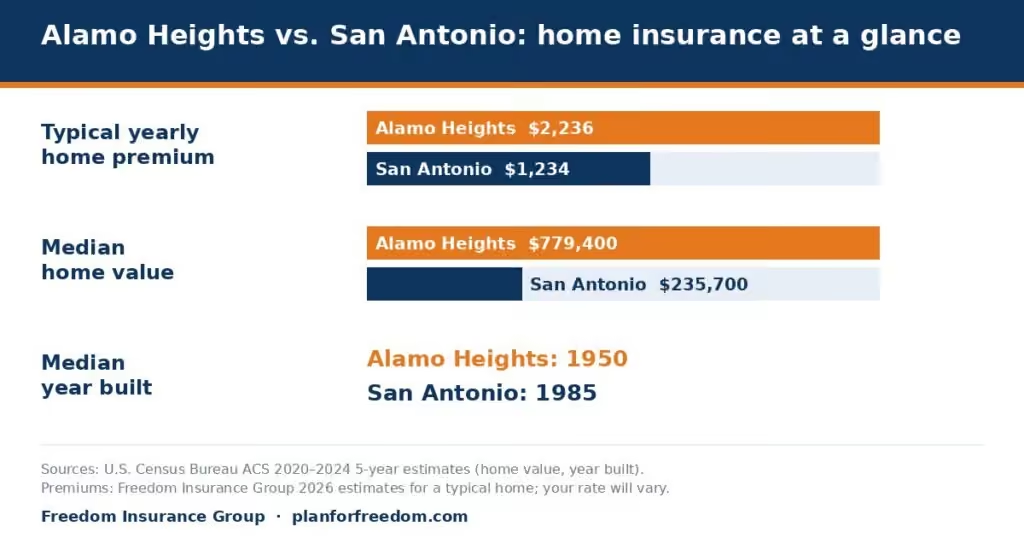
| Measure | Alamo Heights | San Antonio |
|---|---|---|
| Median owner-occupied home value | $779,400 | $235,700 |
| Median year built | 1950 | 1985 |
| Homes built before 1980 | About 74% | About 43% |
| Typical yearly premium | $2,236 | $1,234 |
Sources: Census ACS 2020–2024 for home value, year built and homes built before 1980; our city pages for the typical yearly premium.
The gap comes mostly from what is being insured. A higher dwelling limit raises the premium almost everywhere, and a 1950 median build year means more homes with older roofs, wiring and plumbing for underwriters to review. Both cities sit in Bexar County, so the county’s FEMA hail and tornado ratings apply to each. If you are moving from San Antonio into Alamo Heights, expect to raise your dwelling limit, recheck roof settlement terms and compare percentage wind and hail deductibles in dollars.
See also: Alamo Heights vs nearby cities for Leon Valley and Live Oak.
Alamo Heights vs nearby cities
These figures come from our city pages for each area.
| City | Typical premium | Typical home value | Median year built | Built before 1980 | Hail reports within 5 mi, 2016–2025 |
|---|---|---|---|---|---|
| Alamo Heights | $2,236 | $779,400 | 1950 | About 74% | 40 |
| Leon Valley | $1,246 | $253,200 | 1978 | About 56% | 50 |
| Live Oak | $1,229 | $246,300 | 1990 | About 33% | 18 |
Alamo Heights premiums run higher mainly because homes are worth more and are older, not because hail is more frequent. Leon Valley logged more hail reports over the same period.
See also: How Alamo Heights differs from San Antonio for the Census comparison.
What drives your home insurance price in Alamo Heights
In short
- Rebuild cost, roof age and type, and storm exposure matter most.
- Your deductible and claims record can move the price as much as the carrier brand.
Carriers look at several connected factors together when they price an Alamo Heights homeowners quote. Rebuild cost, the roof’s age and type, and local storm or wildfire exposure usually matter most. The deductible you pick and your claims record can also shift the final price as much as the carrier brand.
Home value and rebuild cost
With the city’s high median home value, dwelling limits here run well above the Texas average, which raises premiums. Replacement cost is the cost to rebuild the home with comparable materials at today’s prices for labor and supplies. Since the carrier’s top payout grows with the rebuild estimate, bigger estimates for Alamo Heights homes tend to push up premiums.
Older homes and construction type
Houses built before 1980 may need updated wiring, plumbing or roofs before some carriers will write them. Construction type matters too: underwriters check whether walls are frame or masonry and how solidly the home is built, because those details decide how it fares in wind, hail, and fire events common across Texas.
Roof age, material and condition
Underwriters check the roof covering, and its age, material and condition drive both the price and how a hail claim is paid. See Roofs, hail and how claims are paid for replacement cost versus actual cash value.
Location and fire protection
Storm, hail, wildfire, and crime scores can differ from block to block within Alamo Heights and from neighboring San Antonio ZIP codes, so two homes with similar rebuild costs may still price differently.
Fire protection counts as well: a nearby hydrant, a short drive to the fire station and a good local protection class can each help lower the price.
Your deductible choice
The Texas Department of Insurance (TDI) says raising a deductible from $500 to $1,000 can lower the premium by up to 20%. See Percentage wind and hail deductibles for how a percentage wind and hail deductible works out in dollars.
Claims, credit and discounts
Your claims history is still a major rating input: recent claims on the property or household tend to raise rates for Alamo Heights renewals and new business quotes alike, and they can also limit your options.
A credit-based insurance score also plays a role where rules allow: carriers that use it tend to price lower to applicants with better scores. Most Texas carriers use credit-based scores and discounts, so results vary by household.
See also: Common discounts for Alamo Heights, TX homeowners for credits you may qualify for, and Steps to shop for home insurance in Alamo Heights for how to compare quotes.
Common discounts for Alamo Heights, TX homeowners
| Discount | What it means | Typical amount |
|---|---|---|
| New Home | New construction recently purchased | up to 40% |
| Age of home (5 yrs) | Newer homes | up to 26% |
| Bundle | Home and auto together | up to 25% |
| Upgrades | Electrical, plumbing, heating, roof updates | up to 20% |
| Hail-resistant roof | Class 1–4 impact roof (Class 4 is the most impact-resistant rating and earns the highest credit) | up to 12% |
| Paid in full | Pay annual premium upfront | up to 7% |
| Claims-free | Multi-year claims-free history | up to 5% |
| Security / alarms | Monitored fire or burglar alarm | up to 4% |
Discounts and their size differ from carrier to carrier. “Up to” shows the maximum, not a promise.
Home-and-auto bundles in Alamo Heights, TX
Estimated yearly savings from bundling home and auto. These are illustrated averages, not guaranteed; actual savings come down to carriers and drivers.
| Place | Est. yearly savings, 1-car bundle | Est. yearly savings, 2-car bundle | Est. yearly savings, 3-car bundle |
|---|---|---|---|
| Alamo Heights, Texas | $258 | $436 | $636 |
Want car rates and coverage details on their own? See our Alamo Heights car insurance page.
Texas homeowners policy forms: HO-A, HO-B (HO-3) and HO-C (HO-5)
In short
- For a high-value Alamo Heights home, an HO-B (HO-3) or HO-C (HO-5) form is usually the better fit. HO-A covers only listed (named) perils; HO-B covers the house against any cause not excluded; HO-C extends that to belongings.
TDI groups Texas homeowners policies into four types. Companies may use their own approved forms, so always read the policy itself.
| Texas form | Similar national form | What it covers |
|---|---|---|
| HO-A | HO 1 | Named perils for the house and belongings. Basic coverage. |
| HO-A+ | HO 2 | Named perils with more of them listed, such as falling objects and freezing pipes. |
| HO-B | HO 3 | Open perils for the house (anything not excluded) and named perils for belongings. |
| HO-C | HO 5 | Open perils for both the house and belongings. The broadest form. |
Homeowners policy coverages, A through F
- Dwelling (Coverage A): After a covered loss, this limit rebuilds your home’s structure; set it to match today’s local rebuild costs.
- Other structures (Coverage B): Covers sheds, fences, detached garages and other structures separate from the main house.
- Personal property (Coverage C): Your furniture, clothes, and everyday belongings in the home are protected, but some higher-value categories carry special sublimits.
- Loss of use (Coverage D): Extra living expenses while the home is being repaired after a covered claim forces you out.
- Personal liability (Coverage E): If you are legally responsible for injuring another person or damaging their things in a covered incident, this coverage steps in.
- Medical payments (Coverage F): Pays the medical bills of guests hurt on your property no matter who was at fault, plus some injuries away from home, such as your dog biting someone at the park.
Coverage gap: standard Texas homeowners policies do not cover flood or earthquake damage, according to TDI. Flood needs a separate policy with a usual 30-day wait; see our Alamo Heights flood insurance page. Earthquake coverage, if you want it, is an add-on.
Insuring an older Alamo Heights home
In short
- Insure for rebuild cost, not market value; TDI notes most companies require coverage of at least 80% of replacement cost, and some require 100%.
- Check whether a hail-damaged roof is paid at replacement cost or actual cash value.
- A 1% wind and hail deductible on a home near the local median value comes to several thousand dollars.
Alamo Heights was incorporated on June 20, 1922, and many houses still date from the decades that followed. The city sits about 4.5 miles north of downtown San Antonio, next to Terrell Hills and Olmos Park. With about three in four homes owner-occupied and values more than three times San Antonio’s, most policies here are written on high-value, owner-lived houses.
Roofs, hail and how claims are paid
A single hailstorm can damage a roof, so how the policy pays for one matters. TDI explains that a replacement cost policy pays to replace a damaged roof without taking off for wear, while an actual cash value policy subtracts depreciation. In TDI’s example, a ten-year-old roof costing $10,000 to replace might pay only about $7,000 before the deductible under actual cash value. Many Texas carriers settle older roofs on actual cash value, so check this line before you compare prices.
Percentage wind and hail deductibles
Some policies use a separate wind and hail deductible set as a percentage of the dwelling limit. If your dwelling coverage is $779,400 (about the local median home value), a 1% deductible is $7,794 and a 2% deductible is $15,588 for a single hail claim. A lower premium with a 2% deductible may not save money once a storm hits.
Flood risk near Olmos Creek and the Olmos Basin
Standard homeowners policies do not cover flood. Olmos Dam, built from 1925 to 1927, protects downtown San Antonio by holding back floodwater in the Olmos Basin just west of the city. The San Antonio River Authority and Bexar Regional Watershed Management publish flood maps you can search by address. Lenders require flood insurance in mapped Special Flood Hazard Areas, and TDI notes that a new flood policy usually takes 30 days to start, so do not wait for a storm forecast.
Older-home issues insurers look at in Alamo Heights
With a median year built of 1950, many Alamo Heights homes have had several owners and several rounds of updates. Insurers price and accept these homes based on the systems in them now, not just the build date. The Texas Department of Insurance notes that companies can’t turn you down just because of your home’s age or value, but they can charge you more.
- Wiring: keep records of panel and wiring updates. Original wiring in a 1950s home is a common question on applications and inspections.
- Plumbing: TDI lists continuous or repeated leaks or seepage among common exclusions, so slow leaks from older pipes are usually not covered. Sudden, accidental water damage usually is.
- Foundations on clay: the Texas Master Naturalist guide to Bexar County soils notes that much of the county sits on Houston Black clay, which swells when wet and shrinks when dry, and calls it the main reason for foundation problems in the county. TDI lists foundation and slab damage as an add-on many companies sell, which means a basic policy may not cover it. You can check your lot on the NRCS Web Soil Survey.
- Building code upgrades: TDI lists extra costs to meet local building codes as an endorsement. After a big claim on an older house, code updates can add real cost.
Rebuild cost is not market value. The median home value counts the lot as well as the house, and in an established close-in city like Alamo Heights the land can be a large share of what a home sells for. Your Bexar Appraisal District record lists land and improvement values separately. A homeowners policy insures what it would cost to rebuild the house, not the lot, and TDI says most insurers require the house to be covered for at least 80% of what it would cost to replace, while some ask for 100%. Older homes with plaster walls, custom millwork and trim, original wood floors, slate or tile roofs or pier-and-beam foundations can cost more per square foot to rebuild than a newer tract home of the same size. Ask each carrier how it estimates rebuild cost and for a replacement-cost estimate, update it after a remodel or addition, and ask about extended replacement cost (extra coverage that pays more if your dwelling limit does not cover the rebuild) and ordinance-or-law (building code) coverage (extra costs to meet current building codes after a loss), both of which TDI lists among common add-ons, and whether the carrier offers guaranteed replacement cost.
See also: Newer homes in Alamo Heights for how rebuilt and recent homes compare, and High-value homes and extended replacement cost for setting your dwelling limit.
Newer homes in Alamo Heights
In short
- About 11.7% of housing units were built in 2000 or later.
- The city has adopted the 2021 International Residential Code.
- New home credits run up to 40% and impact-resistant roof credits up to 12%, depending on the carrier.
Not every Alamo Heights home is from the 1950s. Census data (ACS 2020–2024) count about 11.7% of Alamo Heights housing units as built in 2000 or later, and about 6.1% in 2010 or later. These newer homes are insured differently from the original houses around them.
Codes, roofs and systems
- Current codes: the City of Alamo Heights has adopted the 2021 International Residential Code, the 2021 International Building Code and the 2020 National Electrical Code. A home permitted under them has wiring, plumbing and framing built to current standards, which removes many of the questions underwriters ask about 1950s houses.
- Impact-resistant roofs: TDI says roofing tested for impact resistance is rated Class 1 to 4, and a Class 4 roof covering gets the highest premium credit. Each company sets its own discount, so ask your roofer or builder for TDI form PC068, or the carrier’s own form, and send it to your insurer.
- New systems: new electrical, plumbing and heating mean fewer of the water and wiring questions that come up with older homes.
Insurance during construction
A home under construction is usually insured with a builder’s risk policy rather than a homeowners policy. Carriers that write it describe it as covering the structure being built and materials on site, often for a 12-month term that can be extended. Confirm in your building contract who carries builder’s risk and when it ends, and start your homeowners policy on the day you close or take occupancy so there is no gap.
How premiums may compare
Newer homes often qualify for discounts older homes cannot. The discounts table on this page shows new home credits of up to 40% and age-of-home credits of up to 26%, and impact-resistant roof credits of up to 12%, though amounts vary by carrier. High values still matter: a new Alamo Heights home can carry a large dwelling limit, so set it from a replacement-cost estimate based on the finishes you actually chose, and recheck it after any upgrade.
See also: Insuring an older Alamo Heights home for the 1950s-house side of the comparison.
High-value homes and extended replacement cost
In short
- The biggest risk at these values is being underinsured after a total loss.
- Ask about extra construction cost coverage and schedule valuable items separately.
The median owner-occupied home here is worth roughly three times the typical home in Leon Valley or Live Oak. At that level, the biggest risk is being underinsured after a total loss, when labor and materials can cost more than expected.
- Ask whether the policy includes extra construction cost coverage. TDI lists this as an add-on that pays more if your limit does not cover the rebuild.
- Schedule jewelry, art and collections separately. TDI notes a standard policy provides some coverage but it might not be enough for expensive items.
- Raise liability limits to match your assets, and consider an umbrella policy with your auto coverage.
- Recheck the dwelling limit after any remodel, since custom finishes raise rebuild cost.
See also: the rebuild cost note in Insuring an older Alamo Heights home.
TWIA and the Texas FAIR Plan in Alamo Heights
In short
- TWIA (the Texas Windstorm Insurance Association, which sells wind and hail coverage only in coastal areas) does not apply in Alamo Heights; your homeowners policy covers wind and hail.
- The Texas FAIR Plan (a basic home insurance option of last resort) is a fallback once at least two companies have turned you down.
The Texas Windstorm Insurance Association (TWIA) only sells wind and hail coverage in the 14 first-tier coastal counties and part of Harris County east of Highway 146. Bexar County is not in that area, so TWIA does not apply in Alamo Heights. Your regular homeowners policy covers wind and hail here, subject to its deductible.
The Texas FAIR Plan Association sells basic home insurance as a fallback. TDI says you can get FAIR Plan coverage if you cannot find a Texas-licensed company to insure you and at least two companies have turned you down. Surplus lines companies are another option for hard-to-place homes.
See also: the TWIA and FAIR Plan questions in the FAQs.
Neighborhoods in and near Alamo Heights
- Olmos Park: a separate, mostly residential city on the west side of Alamo Heights, next to the Olmos Basin.
- Terrell Hills: a separate residential city on the east side of Alamo Heights.
- Oak Park–Northwood: a San Antonio neighborhood in the northern part of 78209, inside Loop 410 between N. New Braunfels Ave. and Harry Wurzbach Rd., with homes dating from the 1950s.
- Terrell Heights: a San Antonio neighborhood of about 820 homes, established in 1942, with mostly mid-century houses.
- Mahncke Park: an early 20th-century streetcar neighborhood along Broadway, bordered by Alamo Heights, Terrell Hills, Brackenridge Park and the San Antonio Botanical Garden.
Where we write coverage around Alamo Heights
Alamo Heights itself is in ZIP 78209, and we also quote homes in nearby San Antonio ZIP codes.
78209 · 78212 (Olmos Park) · 78218 · 78217 · 78216
Alamo Heights housing stock and storm history
In short
- 40 hail reports within about 5 miles from 2016 through 2025; 35 were one inch or bigger.
- FEMA rates Bexar County “Very High” for hail and tornado.
- Median year built is 1950, and roughly 74% of homes were built before 1980.
NOAA’s Storm Events Database lists 40 hail reports within about 5 miles of Alamo Heights from 2016 through 2025; 35 were one inch or bigger. The largest, 4 inches, was reported in April 2016 near Kirby, a separate city about 5 miles east of Alamo Heights.
From 2000 on, Bexar County has been part of 8 major disaster declarations; the most recent was Severe Winter Storms (February 2021).
In FEMA’s National Risk Index, Bexar County is rated “Very High” for hail and tornado, “Relatively High” for winter weather and “Relatively Moderate” for wildfire.
Alamo Heights’ median year built is 1950. Roughly 74% of homes were built before 1980, so wiring, plumbing, and roof updates often come up in underwriting.
More housing and storm history data for Alamo Heights
The Census Bureau’s 2020–2024 American Community Survey counts about 3,701 housing units in Alamo Heights, and homeowners occupy about 74% of the occupied homes. Of all units, 67% are detached single-family houses and 29% are in buildings with two or more units.
Occupied homes in Alamo Heights are heated mostly with electricity (48%), utility gas (48%), and propane or other bottled gas (3.7%). Wood stoves and propane tanks are items underwriters ask about, because they can affect eligibility.
Terrell Hills, to the east, and Olmos Park, to the west, are separate small, mostly residential cities that border Alamo Heights. Older and newer sections can quote differently based on build era, roof, and fire protection.
Tornado history matters here as well: NOAA logged 4 tornadoes starting within 10 miles of Alamo Heights over 2016–2025, with the strongest an EF2 in February 2017.
Alamo Heights’ population was 7,319 at the 2000 Census, 7,031 at the 2010 Census and 7,357 at the 2020 Census, and the Census Bureau’s July 2025 estimate is 7,632. Numbers have held fairly steady since 2000.
Going further back, SPC data show 126 hail reports within 5 miles of Alamo Heights between 1955 and 2015; the biggest stones, 4 inches, fell on May 6, 2001. Twelve of those reports were 2 inches or larger. The NOAA Storm Prediction Center database shows 27 tornadoes that began within 10 miles of Alamo Heights from 1950 through 2015; the strongest was an F3 on April 28, 1953. That tornado’s record lists 1 death and 5 injuries.
Comparing homes in nearby towns? Each nearby home insurance page answers a different question:
- San Antonio surrounds Alamo Heights. Its homes are newer on average, and its typical premium is about $1,234, so it shows how much of the Alamo Heights price comes from home value and age.
- Leon Valley (9 mi) is a good benchmark for 1970s-era houses, with a median year built of 1978 and more hail reports than Alamo Heights over 2016–2025.
- Live Oak (9 mi), with a median year built of 1990, shows how newer construction prices out in the same metro area.
Saving on home insurance in Alamo Heights
- Shop more than one carrier, since risk appetite varies.
- Bundle home and auto when it actually lowers the package price.
- Raise deductibles only if you can handle the out-of-pocket hit.
- Ask about roof, alarm, and claims-free credits that fit your home.
See also: Steps to shop for home insurance in Alamo Heights for the full checklist.
Steps to shop for home insurance in Alamo Heights
- Gather your home’s details. Have the year built, square footage, roof age and material, and any updates to wiring, plumbing or heating ready before you call. With a median year built of 1950 here, carriers ask about older systems, so keep the roof invoice or a recent roof inspection report, plus receipts and permits for updates, to show an underwriter. Your Bexar Appraisal District record lists land and improvement values separately, which helps when you talk about the house rather than the lot.
- Get your quotes. Request a free home quote online, call us at (800) 253-1482, text (972) 798-3769, or email quotes@planforfreedom.com, and we will compare 25+ carriers for your Alamo Heights home on the same coverage and deductibles.
- Compare the same deductibles on every quote. Line up the all-perils deductible and any percentage wind and hail deductible in dollars; the worked example in Percentage wind and hail deductibles shows what 1% and 2% mean at the local median value. Raising a deductible from $500 to $1,000 can lower the premium by up to 20%, so only compare prices built on matching deductibles.
- Check how the roof is settled. Ask whether a hail-damaged roof is paid at replacement cost or actual cash value. In the state’s example, a ten-year-old roof costing $10,000 to replace might pay only about $7,000 before the deductible on actual cash value, which matters in a county FEMA rates “Very High” for hail.
- Review your other coverage limits. Check personal property (Coverage C), loss of use (Coverage D) and personal liability (Coverage E). With home values this high, consider raising liability limits and adding a separate umbrella liability policy, and schedule jewelry, art or collections a standard policy might not fully cover.
- Look at exclusions and add-ons. Standard Texas homeowners policies do not cover flood, so price a separate flood policy early; most new flood policies take 30 days to start (see our Alamo Heights flood insurance page). Common add-ons include backup of sewers or drains, foundation or slab damage, and ordinance-or-law (building code) coverage, all worth asking about for older Alamo Heights homes on clay soils.
- Ask about discounts and send proof. Each company sets its own discounts, so ask about monitored alarms, sprinklers, impact-resistant roofs, newer or well-kept homes, bundling with auto and claims-free credits. For a Class 4 roof, get form PC068 (or the company’s own form) from your roofer and send it in. HelpInsure.com shows which discounts companies offer.
- Check the company, not just the price. Confirm the company and agent are licensed by calling the state insurance Help Line at 800-252-3439, look up the company’s complaint record in the state’s complaint data, and ask for its financial strength rating before you choose.
- Time your switch so there is no gap. Never cancel your current policy until you have the new policy or a written statement of coverage. Start the new policy on or before the day the old one ends; if you cancel mid-term, the old company must refund any unearned premium within 15 days.
See also: Saving on home insurance in Alamo Heights for four quick ways to lower the price.
What to do after a hail claim in Alamo Heights
In short
- Report the claim quickly; some policies have a one-year deadline.
- Your company must acknowledge the claim within 15 days.
- A contractor cannot legally waive, rebate or absorb your deductible.
Spring storms can leave dents on roofs, gutters and cars on the same afternoon. The Texas Department of Insurance (TDI) suggests these steps:
- Tell your insurance company as soon as you can. Some policies have a one-year deadline to file unless you can show good cause for the delay.
- Take photos or video of the damage and make a list of damaged items, including small ones.
- Make only the repairs needed to prevent more damage, such as a tarp, and keep every receipt.
- Be there when the adjuster inspects. TDI says it is a good idea to have your contractor there, too.
- If the damage turns out to be worse than first estimated, you or your contractor can ask the adjuster to raise the estimate.
Deadlines your insurance company must meet
Under Texas law, your company must tell you it received your claim within 15 days. It must accept or deny the claim within 15 business days after it gets all the information it needs, and explain any denial in writing. Once it agrees to pay, it must send payment within five business days. TDI notes these deadlines can be longer after major disasters.
Public adjusters
A public insurance adjuster works for you, not the insurer, and must be licensed by TDI. Fees can be up to 10% of what the company pays on the claim. Public adjusters cannot also act as your contractor, cannot knock on your door for business during a natural disaster or after 9 p.m., and cannot take referral fees from contractors or attorneys. You can confirm a license by calling TDI at 800-252-3439.
Roofers and your contract
Texas law does not let a roofer or contractor act as your public adjuster on a job they are also doing, or advertise that they will handle your claim. It is also illegal for a contractor to waive, rebate or absorb your deductible. Contracts of $1,000 or more that involve an insurance settlement must include a notice that you must pay the deductible, and your insurer can ask for proof that you paid it. If you sign with a door-to-door salesperson, the Texas Attorney General says you may have three business days to cancel covered sales. Report deductible offers to the Attorney General at 800-621-0508.
See also: Roofs, hail and how claims are paid for how roof claims are settled, and the deductible questions in the FAQs.
Alamo Heights home insurance FAQs
How much is home insurance in Alamo Heights?
The typical premium is about $2,236 a year on a home near the local median value. Your price depends on rebuild cost, roof, deductible and claims history. For comparison, our San Antonio page puts its typical premium near $1,234.
Does homeowners insurance cover flooding in Alamo Heights?
No. Flood needs a separate policy, and TDI notes that most new flood policies take 30 days to begin. You can check your address on the Bexar Regional Watershed Management flood map before you buy.
How often does hail hit Alamo Heights?
NOAA lists 40 hail reports within about 5 miles from 2016 through 2025, and 35 were one inch or larger. FEMA’s National Risk Index rates Bexar County “Very High” for hail.
Why are older Alamo Heights homes harder to insure?
Original wiring, plumbing and older roofs raise claim risk, and custom materials raise rebuild cost. Updates and a newer roof often open up more carriers. TDI notes that companies can’t turn you down just because of your home’s age or value, but they can charge you more. Keep receipts and permits for updates to show an underwriter.
Should I choose replacement cost or actual cash value for my roof?
Replacement cost pays more after a hail claim but usually costs more up front. Compare both on the same deductible before deciding. In TDI’s example, a ten-year-old $10,000 roof might pay about $7,000 on actual cash value.
How long do I have to file a hail claim in Texas?
Tell your company as soon as possible. TDI notes some policies have a one-year deadline unless you can show good cause for the delay. Once you file, your company must acknowledge the claim within 15 days.
Can a roofer pay or waive my deductible?
No. Texas law makes it illegal for a contractor to waive, rebate or absorb your deductible, and your insurer can ask for proof you paid it. Report a waiver offer to the Texas Attorney General at 800-621-0508.
Do I need TWIA coverage in Alamo Heights?
No. TWIA only covers the first-tier coastal counties and part of Harris County. Bexar County homes get wind and hail coverage on a regular homeowners policy, subject to that policy’s deductibles.
When can I use the Texas FAIR Plan?
TDI says the FAIR Plan is available if you cannot find a Texas-licensed company to insure you and at least two companies have turned you down. FAIR Plan policies are basic, so compare them with surplus lines options.
Are wind and hail deductibles required in Alamo Heights?
No city rule sets them; it depends on the policy. Some policies use a separate wind and hail deductible set as a percentage of the dwelling limit, so on a home near the local median value even a 1% deductible is several thousand dollars. TDI advises checking what a percentage deductible means in dollars before you buy.
Which roof type gets the best rates in Alamo Heights?
TDI says impact-resistant roofing tested to a recognized standard is rated Class 1 to 4, and a Class 4 roof covering gets the highest premium credit. Each company sets its own discount, so ask your roofer for the TDI PC068 installation form or your insurer’s version and send it to your company.
See more Texas insurance resources
Sources for Alamo Heights facts
- U.S. Census Bureau QuickFacts: Alamo Heights city, Texas
- City of Alamo Heights: History
- City of Alamo Heights: Facts
- Texas Department of Insurance: Homeowners insurance guide
- TDI: Replacement cost or actual cash value
- TDI: Deductibles
- San Antonio River Authority: Olmos Dam
- Bexar Regional Watershed Management: Know your flood risk
- NOAA Storm Events Database
- TDI: Texas homeowners policies (policy forms)
- TDI: Public insurance adjusters
- TDI: Roofing and insurance, know the law
- TDI: Can a contractor waive my deductible?
- Texas Attorney General: Door-to-door sales and the 3-day right to cancel
- TWIA: Coverage and eligibility
- Texas FAIR Plan Association
- Alamo Area Texas Master Naturalists: Bexar County soils
- USDA NRCS Web Soil Survey
- FEMA National Risk Index (December 2025 release)
- Census ACS 2020–2024: median year structure built (B25035)
- Census ACS 2020–2024: year structure built (B25034)
- U.S. Census Bureau QuickFacts: San Antonio city, Texas
- TDI: Impact-resistant roofing credits
- TDI form PC068: Impact-resistant roofing installation
- City of Alamo Heights Code: codes adopted by reference (2021 I-Codes)
- City of Alamo Heights: City codes and ordinances
- Bexar Appraisal District
- US Assure: Builders risk for residential new construction (FAQ)
- TDI: Tips to help you shop for homeowners insurance
- TDI: Complaint data resources
- HelpInsure.com (TDI and the Office of Public Insurance Counsel)
Compare home insurance quotes for Alamo Heights, TX
In Alamo Heights, Freedom Insurance Group compares 25+ carriers. Request a free home quote online, call us at (800) 253-1482, text (972) 798-3769, or email quotes@planforfreedom.com.

About the author
Insurance Agent, Freedom Insurance Group
Jenny is a licensed insurance agent with 20 years in the insurance industry (12 years licensed). She spent a long stretch of her career at Progressive, later worked with Texans Insurance Agency, and now helps families compare home and auto coverage across many carriers at Freedom Insurance Group, explaining limits, deductibles and endorsements in plain English.
